A box of whitening strips on a Kitchener pharmacy shelf and a whitening service on a dental clinic’s website can sound like two versions of the same thing. Add the phrase “take-home whitening,” and the labels become less clear. Does “at home” always mean store-bought? Does “professional” always mean an appointment in the dental chair?
This guide to professional vs at-home teeth whitening separates those terms. We’re comparing how the products are supplied, the formats involved and where professional oversight fits. It is an explanation of the categories, not a recommendation to whiten your teeth, buy a particular kit or choose one treatment over another.
Professional whitening can also happen at home
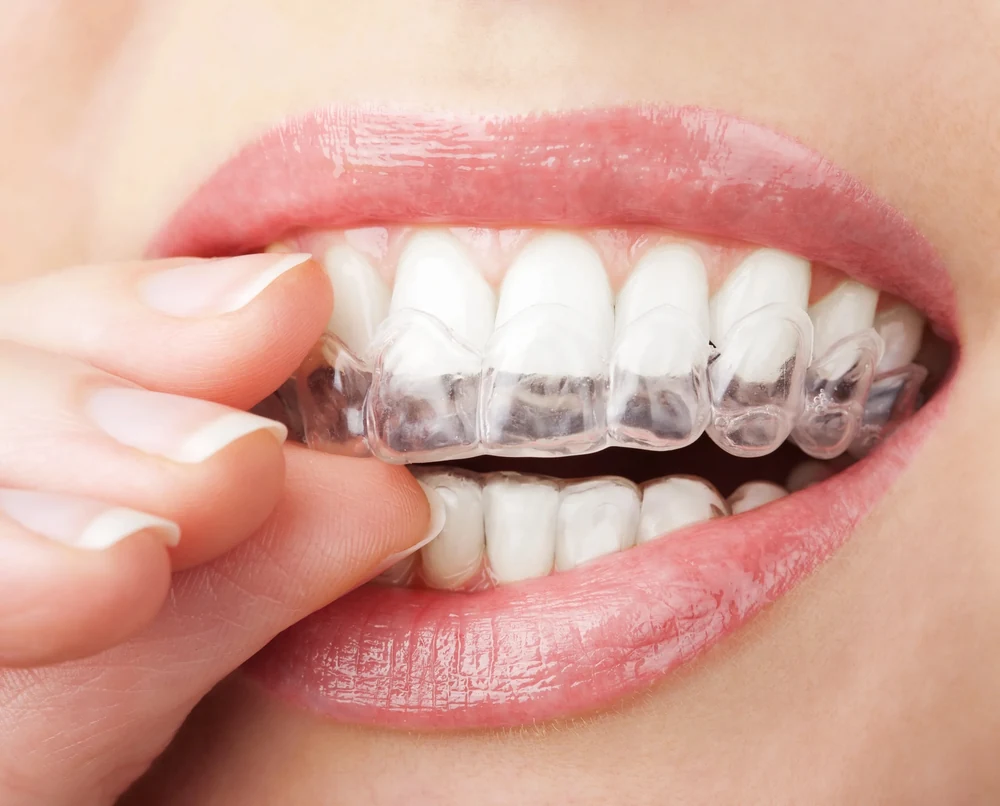
The American Dental Association’s patient website describes both in-office bleaching and dentist-provided take-home bleaching. In the first, the dental team carries out the procedure at the office. In the second, a dentist can supply a custom-made tray for use away from the clinic. The dentist provides the product-specific instructions as part of that arrangement.
That makes “professional” and “at home” different kinds of descriptions. One concerns professional involvement; the other identifies the location. A dentist-provided take-home system belongs to both categories. Calling every home-use kit “over the counter” would leave out this distinction.
The same ADA overview describes chairside bleaching with material protecting the gums while a bleaching product is applied to the teeth. A custom take-home tray is a different delivery format. Neither description tells us which services a particular dental office offers. The ADA’s explanation of teeth whitening provides the general categories; it is not a Nordic Dentistry product list. This article does not reproduce application steps or suggest a schedule for either format.
What store-bought formats include
Over-the-counter products are supplied directly to consumers. The ADA’s professional overview lists strips, paint-on gels, tray-based products and toothpastes among the formats. That is a varied group, rather than one uniform kit with a standard formulation.
The word “whitening” also covers different product actions. The ADA describes whitening toothpastes as relying mainly on abrasives to remove surface stains, although some contain peroxide. Most whitening strips principally use peroxide bleaching. A toothpaste and a bleaching strip therefore are not simply different packaging for an identical product.
Its overview also describes the ADA Seal of Acceptance as a voluntary programme for over-the-counter oral-care products. Professional products supplied or applied by dentists are not eligible for that programme. The presence or absence of that particular seal is therefore not a way to classify every whitening product on a single professional-versus-retail scale.
These distinctions come from the ADA’s whitening topic review. They describe formats and the scope of a product programme, not an endorsement of a brand or a claim that one category suits every person.
A home-use label does not describe the whole arrangement
Health Canada’s consumer information identifies strips, paint-on products and tray kits as examples sold directly to consumers. It also describes home-use products supplied through oral health professionals, with professional instructions and a direct point of contact. Both can be used outside a dental office, while the way they are supplied differs.
The same information explains that formulations vary with the delivery method. Peroxide or peroxide-generating compounds are common whitening ingredients, including hydrogen peroxide and carbamide peroxide. The package format alone does not describe every aspect of the formulation. Likewise, the presence of the same named ingredient does not establish that two products are identical.
Health Canada notes that directions vary between products. That is why this comparison contains no universal application time, quantity or sequence: it would turn a description of several different product categories into a set of instructions. The Health Canada overview of home tooth-whitening kits is the source for these product and supply distinctions. We are not reproducing its treatment advice or applying it to any individual reader.
Why research comparisons need precise labels
Research titles can use “at home” in a narrower way than everyday conversation. A 2024 umbrella review compared in-office bleaching with clinically supervised at-home bleaching. Its eligibility criteria excluded studies in which participants used over-the-counter products. The home-use group in that review was therefore not a stand-in for everything available on a shop shelf.
The review brought together systematic reviews of trials involving adults and professional external tooth bleaching. It considered differences between professional techniques, including products and protocols. That scope matters when interpreting what the comparison can actually tell us.
For example, a finding about dentist-supervised trays cannot automatically establish the same result for a retail strip or paint-on product that was excluded from the research. Nor is a study title a description of a clinic’s current offering. The distinction is visible in the methods of the 2024 review by Aidos and colleagues. We cite it here to clarify the comparison groups, without turning research on professional methods into a ranking of store-bought kits.
Whitening information at Nordic Dentistry
Our Teeth Whitening page contains Nordic Dentistry’s service information. This article explains the terminology around professional and store-bought formats; it does not add a particular brand, device or take-home system to the clinic’s offering.
For someone reading about whitening in Kitchener-Waterloo, the useful distinction in this comparison is between a retail product, a professionally supplied home-use system and an in-office service. This guide describes those arrangements without selecting one for you or promising an outcome.
This article is general educational information only. It does not provide medical or dental advice, a diagnosis, or treatment recommendations.
To book a consultation with Nordic Dentistry in Kitchener, use our appointment request page.
One Reply on “Professional Teeth Whitening vs Store-Bought Kits: What’s the Difference?”